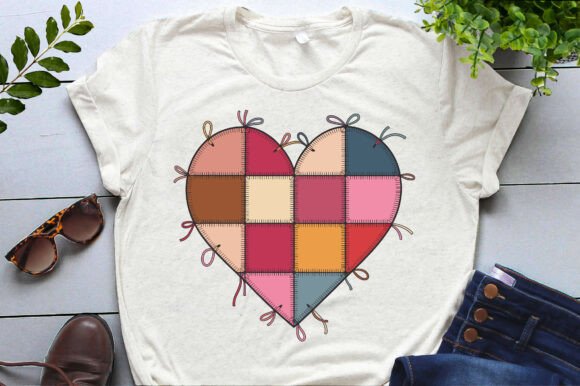
Patchwork Heart Valentine’s Day PNG SVG
As a designer who’s stitched hundreds of holiday-themed pieces—from boutique baby onesies to Etsy-ready embroidered totes—I opened Patchwork Heart Valentine’s Day PNG SVG expecting charm, but what stood out immediately was its quiet confidence. It doesn’t shout “Valentine’s!” with glitter or cartoonish hearts—it whispers it, through fabric-like seams, gentle curves, and that unmistakable handmade warmth of quilted patchwork. I pulled it up on my screen while prepping for a client order: custom linen tea towels for a local café’s February gift set. Right away, I knew this wasn’t just another clipart heart—it was a design built to *live* in real embroidery.
A Design That Feels Stitched Before It’s Even Stitched
The layout is deceptively simple: a centered heart composed of irregular, overlapping fabric swatches—some with faint stitch lines, others with subtle grain or tone variation. There’s no text, no lace overlay, no overworked embellishment. That restraint is its strength. As an embroidery designer, I see right through to the stitch logic: clean outer edges for satin-stitched borders, open interior zones ideal for fill-stitch texture or even light appliqué layering, and generous negative space around the shape—critical when hooping curved surfaces like aprons or tapered tote bag corners.
I tested the PNG files first—300 DPI, fully transparent, crisp at 4500×5400px. Perfect for high-res mockups, yes—but more importantly, they scaled cleanly down to 3.5” wide without pixelation, which tells me the vector files (EPS, AI, SVG) are well-constructed, not traced or auto-traced. That matters when converting to machine embroidery format: clean vectors mean fewer anchor points, smoother satin columns, and less risk of jagged corners on dense fill areas.
Where It Shines—and Where to Pause
Shines on:
- Tote bags & canvas aprons: The patchwork aesthetic mirrors natural fabric texture—so it reads as intentional, not “stuck on.” No need to hide stitching; the design invites visible thread play.
- Linen tea towels & kitchen linens: Soft contrast, low visual noise—pairs beautifully with natural fibers and earthy thread palettes (think oatmeal, brick red, slate blue).
- Baby items & nursery decor: Gentle scale, no sharp angles or tiny details—safe for delicate garments and heirloom-quality stitching.
- Embroidered patches: Its defined outer edge and internal segmentation make it ideal for heat-seal or sew-on patch production. Each “fabric piece” can be assigned distinct thread colors for depth.
Use carefully on:
- Stretchy fabrics (like knits or lightweight jerseys): The heart’s flat, geometric silhouette needs solid stabilization—don’t skip cutaway or tear-away backing, especially around seam intersections.
- Dark or heavily textured fabrics (corduroy, bouclé, terry cloth): Those subtle tonal shifts in the patchwork won’t read unless you boost contrast with brighter thread or add a light underlay stitch.
- Caps or curved hats: While the shape is symmetrical, its width-to-height ratio (slightly taller than wide) means you’ll want to test hoop placement—avoid stitching too close to the bill curve where distortion creeps in.
- Small hoops (under 4”): You *can* resize it, but go below 3” only if simplifying stitch density—those interior seams may blur or collapse into muddy fills.
What It Does for Your Craft Business
This isn’t just a graphic—it’s a quiet brand amplifier. When I added Patchwork Heart Valentine’s Day PNG SVG to a batch of personalized sweatshirts for a small shop launch, customers didn’t just say “cute.” They said, “It looks like something my grandma would’ve sewn.” That emotional resonance builds trust. It signals care—not just in execution, but in curation. For Etsy sellers, that translates to better photo cohesion, stronger listing storytelling, and repeat buyers who recognize your thoughtful aesthetic across seasons.
It also works hard behind the scenes: the clean transparency and vector flexibility let you drop it into printable mockups instantly—no background removal, no color correction. And because it’s offered as both raster (PNG) and vector (EPS/AI/SVG), you’re covered whether you’re designing digital product previews or prepping for commercial embroidery digitizing.
Practical Notes from the Hoop
Before stitching your first Patchwork Heart Valentine’s Day PNG SVG project:
- Always test on scrap fabric—especially if pairing with textured or dark materials. Check how thread colors interact with base tone.
- Review stitch density in your embroidery software. If converting from vector, watch fill areas: too dense = puckering on lightweight cotton; too sparse = loss of patchwork definition.
- Confirm hoop size and placement relative to garment seams or curves—this design benefits from centered, stable hooping.
- Inspect small details at 200% zoom: those seam lines should translate to crisp running or satin stitches—not broken segments.
- Test black-and-white mockups to gauge contrast balance—essential for gift items where clarity trumps decoration.
- Choose stabilizer intentionally: medium-weight cutaway for structured items (totes, caps); tear-away for softer linens or baby clothes.
- Verify licensing before selling finished embroidered goods or reselling digital versions—this is a Graphics asset, not a commercial-use license by default unless stated.
In short, Patchwork Heart Valentine’s Day PNG SVG earns its place in your Illustrations library not because it’s flashy, but because it’s reliable. It behaves well across mediums, respects fabric integrity, and carries enough visual personality to stand alone—yet stays flexible enough to adapt to your brand voice, your customer’s taste, and your machine’s rhythm. Whether you’re stitching a single personalized pillow cover or scaling for a wholesale holiday line, it arrives ready—not as a shortcut, but as a thoughtful starting point.