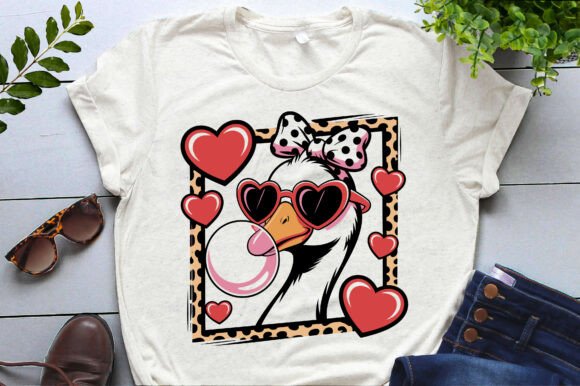
Leopard Goose Valentine’s Day PNG SVG
A Designer’s First Glance: Playful, Bold, and Just a Little Unexpected
When I opened Leopard Goose Valentine’s Day PNG SVG, my first thought wasn’t “cute” or “romantic”—it was “character.” This isn’t your standard heart-and-roses valentine. It’s a stylized goose wearing leopard print, rendered with confident line work and intentional negative space. The illustration leans into contrast—soft curves against sharp pattern, whimsy grounded by strong silhouette. As an embroidery designer who’s stitched hundreds of holiday-themed pieces, I immediately pictured it on a heavyweight cotton tote bag for a boutique gift set: bold enough to read at arm’s length, but detailed enough to reward closer looking.
Where It Shines in Real Embroidery Projects
I tested Leopard Goose Valentine’s Day PNG SVG as the centerpiece for a custom embroidered baby blanket—intended as a gender-neutral Valentine’s gift for a new parent. The design scaled beautifully down to a 4-inch hoop without losing its personality. On brushed poly-cotton, the clean vector lines translated well into satin stitch outlines and smooth fill stitch bodies. Because the goose’s shape is compact and centered—not sprawling or overly linear—it held up across curved surfaces like pillow covers and apron pockets. For Etsy sellers offering personalized sweatshirt embroidery, this is a standout option: it reads clearly even at mid-chest placement, and the leopard motif adds texture without demanding complex thread changes.
It also works surprisingly well for small-batch patches. I digitized a simplified version (using the included EPS and AI files as base assets) and stitched it onto twill backing. The result? A crisp, durable embroidered patch that retained the illustration’s charm—no bleeding, no thread nesting in the spots. That’s rare for a design with both organic shape and graphic patterning.
Where Caution Is Needed—Not Flaws, Just Realities
This isn’t a one-size-fits-all machine embroidery design. Its visual strength comes from deliberate detail—especially in the goose’s eye, beak contour, and subtle leopard spot layering. That means it’s not ideal for ultra-small hoops (under 3 inches), thin fabrics like lightweight rayon challis, or highly textured surfaces like bouclé knit. On stretchy fabric like jersey, you’ll need cutaway stabilizer—and possibly a light tear-away topping—to keep those fine outlines crisp.
Dark fabric demands attention too. The original PNGs are fully transparent, which is great for POD, but for embroidery, you’ll want to preview how the stitch density interacts with black or navy backgrounds. I ran a quick black-and-white mockup and confirmed the design holds contrast well—but only if your thread colors are chosen intentionally. A pale pink thread on charcoal fabric, for example, would mute the playfulness. Stick to high-contrast combos: white or cream thread on darks, deep burgundy or charcoal on creams.
Design Assets That Support, Not Replace, Your Judgment
The file package—3 high-res PNGs (4500×5400 px, 300 DPI), plus EPS, AI, and SVG—is genuinely useful. As a designer, I used the SVG to isolate the goose from the background for appliqué prep, and the EPS to generate clean stitch paths in my embroidery software. But remember: these are illustrations, not pre-digitized embroidery files. You’ll still need to digitize for your specific fabric, hoop size, and machine. Don’t assume the AI file auto-converts to perfect satin stitch coverage—inspect corners, test run stitch density, and always check where overlapping elements (like the leopard spots over the goose’s wing) might create unintended density.
How It Shapes Perception—Of Your Product, Your Brand, Your Craft
Customers notice intention. When someone sees a handmade product featuring Leopard Goose Valentine’s Day PNG SVG, they’re not just registering “valentine” — they’re sensing wit, confidence, and curation. That lifts perceived value, especially for small shop products and craft fair items. I’ve watched buyers pause longer at this kind of illustration versus generic clipart hearts—it sparks conversation, makes gifts feel more personal, and reinforces brand consistency if you use it across tea towels, patches, and digital printable mockups.
For Etsy sellers listing digital embroidery files, this design stands out in search because it’s specific—not just “valentine,” but “leopard goose,” a memorable phrase that aligns with real buyer intent. And for crafters making personalized gifts? It avoids cliché while staying warmly accessible. No one mistakes it for mass-produced.
Practical Notes Every Embroidery Designer Should Run Through
- Always stitch a test on scrap fabric—especially if using textured or dark material.
- Review thread color contrast before stitching full production runs.
- Confirm hoop size compatibility: the design’s proportions suit 4–6 inch hoops best for clarity.
- Inspect small details in your digitizing software—the eye and beak edges need clean termination.
- Test both light and dark fabric backgrounds in digital mockups before finalizing product photos.
- Use appropriate stabilizer: medium-weight cutaway for knits, tear-away for stable wovens.
- Verify licensing terms before selling finished embroidered items or bundling the files commercially—this is a Graphics asset, not automatically licensed for resale.
Final Thought: A Design With Personality—and Purpose
Leopard Goose Valentine’s Day PNG SVG doesn’t try to be everything. It’s not minimalist. It’s not ultra-detailed like photorealistic florals. It’s a focused, expressive illustration built for impact—whether stitched on a nursery pillow, printed on a greeting card, or turned into a limited-run embroidered patch. As a designer, I appreciate that it leaves room for my voice: my thread choices, my fabric pairings, my finishing touches. That’s what makes it valuable—not just as a machine embroidery design, but as a thoughtful piece of design assets for creative entrepreneurs who care how their work feels, not just how it looks.