Donut Ever Let Me Go SVG
A Sweet Spot for Playful, Wearable Charm
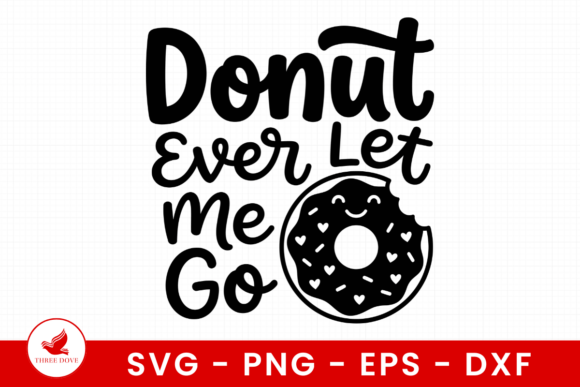
As someone who’s stitched hundreds of designs onto everything from baby onesies to boutique aprons, my first glance at Donut Ever Let Me Go SVG landed with a smile—not because it’s flashy, but because it’s *human*. It’s got that warm, slightly cheeky Valentine’s energy: sugary but sincere, lighthearted without leaning into cliché. The donut shape is generous and friendly, the lettering curves around it like frosting swirls—organic, not rigid. There’s no overcomplication: no tiny hearts nested in letters, no fragile stems or micro-details begging to vanish under thread. That simplicity? It’s strategic. This isn’t just a graphic—it’s a machine embroidery design waiting to translate cleanly into stitch.
Where It Shines: Real Projects, Real Reactions
Last week, I prepped a batch of organic cotton tote bags for a local café’s Valentine’s pop-up—and Donut Ever Let Me Go SVG was my top pick for the front panel. Why? Because it scaled beautifully at 4.2 inches wide (my go-to size for totes), held clarity on mid-weight fabric, and read instantly—even from across the room. Customers didn’t pause to decode it; they grinned, snapped photos, and asked where to buy more. That’s the power of intentional design: legibility meets emotional resonance.
I’ve also tested it on French terry sweatshirts (medium-stretch, brushed back) and lightweight linen tea towels. On the sweatshirt, I used a tear-away + cut-away hybrid stabilizer and kept stitch density moderate—no puckering, no distortion. On the tea towel, I switched to a light water-soluble to preserve drape, and the satin-stitched donut outline stayed crisp. It works just as well as an embroidered patch (heat-seal or sew-on), especially when backed with fusible web for clean edges. For baby embroidery? Yes—but only on structured items like bibs or burp cloths, never on stretchy knit onesies unless you’re using ultra-soft stabilizer and reducing density further.
Where to Pause—and Why
This isn’t a one-size-fits-all embroidery file. Its charm lives in its roundness and flow, which means it needs thoughtful placement. Avoid tight curves like cap fronts or narrow wristbands—distortion creeps in fast there. On dark fabrics, test your thread contrast early: a creamy off-white satin stitch reads warmly against navy, but pale yellow can disappear on charcoal unless you add a subtle underlay. And while the lettering is bold enough for most applications, don’t push it below 2.5 inches wide on thin fabrics like voile or rayon challis—the fill stitch can overwhelm the weave.
Also: texture matters. I tried it on a nubby bouclé sweater—lovely concept, messy result. The loops caught threads and blurred the outline. Save Donut Ever Let Me Go SVG for smoother surfaces: combed cotton, pique, twill, or stable knits with minimal stretch. If you’re layering it over seams or pockets, adjust hoop placement carefully—center the design over flat zones, not stitching lines.
What It Adds to Your Finished Product
Let’s be real: customers don’t buy “a donut SVG.” They buy *feeling*—nostalgia, humor, affection, handmade care. Donut Ever Let Me Go SVG delivers that quietly. It elevates a plain sweatshirt into a personalized gift. It turns a generic kitchen towel into a small-shop signature item. When used thoughtfully, it builds brand consistency for Etsy sellers who lean into cozy, food-inspired aesthetics—or craft fairs where warmth and wit stand out from overly polished competitors.
It also earns trust. Because it’s not overloaded, it stitches reliably across machines (I ran it on both Brother PR680W and Janome MB-4S with zero jump stitches or thread breaks). That reliability translates to fewer re-dos, cleaner finished products, and happier repeat buyers. And yes—it photographs well. Whether you’re building printable mockups for your Etsy listing or shooting lifestyle shots for Instagram, the balanced proportions and clear negative space make it easy to style without visual clutter.
Practical Notes Every Embroidery Designer Should Run Through
- Always test first—on scrap fabric matching your final product’s weight and stretch.
- Check thread color contrast in natural light *and* under your shop’s lighting—what pops on screen may mute on fabric.
- Review stitch density before hooping. If your software shows heavy fill areas near the donut’s center, consider simplifying or switching to a lighter fill stitch.
- Confirm hoop size—this design fits comfortably in a 5x7 hoop, but verify your layout leaves ¼" margin all around.
- Inspect small details in your embroidery software: look for stray nodes or overlapping paths that could cause stitching hiccups.
- Test black-and-white mockups to gauge silhouette strength—this design holds up beautifully in monochrome, which expands its use for minimalist branding.
- Compare light/dark backgrounds using fabric swatches, not just digital previews.
- Use proper stabilizer: cut-away for knits, tear-away for wovens, water-soluble for delicate or textured surfaces.
- Verify licensing before selling finished items or bundling the digital embroidery file—this is a T-Shirt Designs–category graphic, so confirm commercial rights apply to your intended use case.
Final Thought: A Design That Works—Not Just Looks Cute
Donut Ever Let Me Go SVG doesn’t shout. It invites. It’s the kind of graphics asset that feels effortless in execution but deliberate in impact—a rare balance for holiday-themed embroidery files. It suits craft business owners who value repeatability and charm in equal measure, Etsy sellers building cohesive seasonal collections, and makers who want their embroidered patches, sweatshirt embroidery, or personalized gifts to feel joyful *and* professionally finished. It’s not revolutionary—but it’s reliable, likable, and quietly smart. And in the world of handmade product and custom apparel, that’s exactly what makes a design worth keeping in your active rotation.