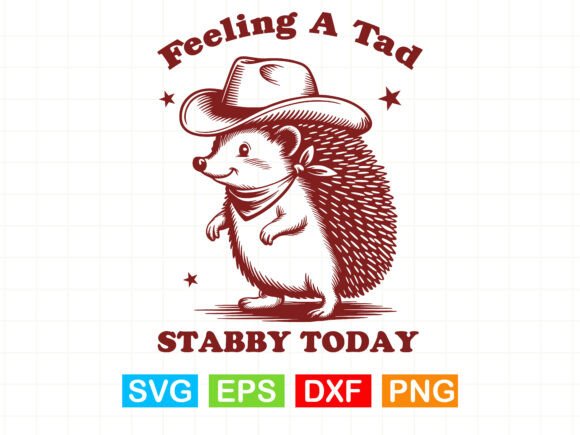
Feeling a Tad Stabby Today SVG
A Designer’s First Glance: Witty, Warm, and Just Sharp Enough
When Feeling a Tad Stabby Today SVG landed in my inbox, I paused—not because it startled me, but because it *landed* so cleanly. It’s not aggressive or edgy for edge’s sake; it’s cleverly self-aware, with soft curves balancing the “stabby” motif. The lettering leans casual but intentional—slightly rounded, slightly uneven, like hand-drawn ink rather than rigid vector perfection. That’s a win for embroidery: organic rhythm translates well to satin stitch flow and thread movement. As a machine embroidery design, its visual personality reads instantly at 3–4 inches wide—ideal for a tote bag front, an apron pocket, or the chest of a relaxed-fit sweatshirt.
Real-World Use: From Mockup to Made-With-Love Product
Last week, I prepped a small-batch run of linen-cotton blend kitchen towels for a local boutique. We chose Feeling a Tad Stabby Today SVG for the lower-right corner—small enough to feel personal, large enough to read without squinting. I tested it first on scrap fabric with tear-away stabilizer (lightweight, since the towel weave is tight but forgiving). The design stitched cleanly: no thread breaks, no puckering, and the slight irregularity in the letterforms actually enhanced the handmade product vibe—like something a friend might’ve sketched before you embroidered it. Customers responded warmly: “It’s sassy but sincere,” one said. That’s the sweet spot—a personalized gift that doesn’t try too hard, yet feels unmistakably human.
Where It Shines—and Where It Needs Careful Handling
Feeling a Tad Stabby Today SVG thrives on stable, medium-weight fabrics: cotton tees, canvas totes, twill caps, and woven baby blankets. Its moderate detail level makes it reliable for sweatshirt embroidery and embroidered patch applications—especially when paired with a simple border or subtle fill stitch background. It also works beautifully as a tote bag design, where readability from a distance matters more than micro-detail.
That said, tread thoughtfully on stretchy knits, ultra-thin voiles, or heavily textured fleece. The letter spacing is friendly, not tight—but tiny serifs or interior corners (like the loop in the “a” or curve of the “g”) can blur if stitch density is too high or stabilizer is under-applied. On dark fabric, avoid light pastel threads unless you’re layering underlay; contrast is your quiet co-pilot here. And while it’s charming on a baby onesie, I’d skip it for newborns—better suited for toddler apparel or nursery decor where humor lands with caregivers, not infants.
Design Integrity in Action: What It Adds to Your Craft Business
As an Etsy seller and small shop owner, I judge designs not just by how they stitch—but by how they make the finished product feel. This one elevates perceived value without demanding premium pricing. It reads as confident, not chaotic; playful, not juvenile. That builds customer trust: buyers sense intention behind the handmade product, not just execution. For commercial embroidery, it scales well across sizes—no need to re-digitize for a cap front versus a pillow cover. And unlike overly intricate applique designs, it doesn’t require extra trimming or alignment steps. Less friction means faster turnaround, fewer returns, and happier clients.
Practical Notes Every Embroidery Designer Should Run Through
- Test on scrap fabric first—especially if using textured or blended fibers.
- Check thread color contrast on both light and dark mockups; this design relies on legibility, not just charm.
- Review stitch density—if your digitizing software allows, soften dense fills slightly for breathable fabrics like t-shirts.
- Confirm hoop size compatibility; while it fits standard 4x4 hoops comfortably, double-check if scaling up for a blanket or down for a cap.
- Inspect small details in black-and-white preview mode—what looks fine on screen may vanish in monochrome stitching.
- Use proper stabilizer: medium-weight cut-away for knits, tear-away for stable wovens, and fusible + tear-away for lightweight linens.
- Verify licensing terms before selling finished items or bundling the digital embroidery file—the product description mentions versatility for prints and mugs, but commercial use rights for physical goods should be confirmed directly with the source.
Final Thought: A Design That Works With You, Not Against You
Feeling a Tad Stabby Today SVG isn’t flashy—but it’s thoughtful. It doesn’t shout. It leans in. That’s rare in a sea of over-digitized, over-engineered T-Shirt Designs and generic Graphics. It respects the craft: the time it takes to hoop, the weight of thread choice, the quiet pride in handing someone a personalized gift that feels seen. Whether you’re stitching for a holiday embroidery pop-up, building a craft business identity, or designing small shop product lines, this design supports your voice instead of competing with it. It’s not just stitched—it’s considered.