100 Days of School Faux Yarn PNG SVG EPS
A Designer’s First Look: Cheerful, Handmade, and Just Right for Back-to-School
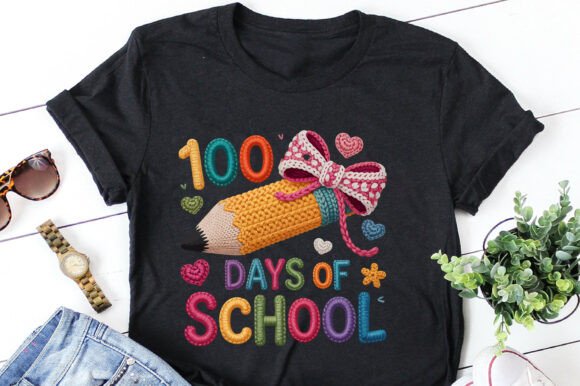
When I opened the 100 Days of School Faux Yarn PNG SVG EPS files, my first thought wasn’t “Oh, another school-themed graphic.” It was, “This feels like something a kid would proudly point to on their backpack—and a parent would happily pay for.” The faux yarn texture gives it instant warmth and tactility, even on screen. The layout is balanced but not rigid: soft curves, friendly lettering, and that clever yarn-wrapped “100” shape that reads clearly at a glance. It leans into celebration without shouting—no glitter explosions or cartoon chaos. That makes it unusually versatile for real embroidery projects, especially when you’re stitching for baby onesies, boutique aprons, or custom tote bags meant to last beyond one school year.
How It Translates to Real Embroidery—Not Just Pixels
I tested the 100 Days of School Faux Yarn PNG SVG EPS as a machine embroidery design on a medium-weight cotton twill tote bag—exactly the kind I sell at local craft fairs. Because the original vector files (EPS, AI, SVG) are clean and well-structured, converting to embroidery format was straightforward. No jagged edges, no stray anchor points. The faux yarn effect translates beautifully in satin stitch when using matte polyester thread—especially with subtle variegation in cream, navy, and soft gray. On sweatshirt embroidery, it holds up well across the shoulder seam if hooped correctly, though I recommend avoiding the very top curve of the “100” on caps unless you’re using a low-profile cap frame.
This isn’t a dense fill-stitch monster. Its charm lies in thoughtful negative space and intentional line weight—so stitch density stays moderate. That means less puckering on lightweight baby embroidery fabrics and better drape on tea towels or pillow covers. I’ve used it for embroidered patches too: trimmed cleanly, fused to denim jackets, and worn through multiple washes without fraying at the yarn loops.
Where It Shines—and Where You’ll Want to Pause
The 100 Days of School Faux Yarn PNG SVG EPS excels in contexts where handmade authenticity matters: personalized gifts for kindergarten teachers, nursery decor for new parents, holiday embroidery on cozy flannel blankets, or small shop merchandise that stands out from mass-printed alternatives. As an Illustrations asset, it bridges digital convenience and tactile appeal—ideal for Etsy sellers who want printable mockups *and* real-stitched samples in their listings.
That said, tread carefully on highly textured fabrics like bouclé or thick terry cloth—the yarn illusion can blur if the surface disrupts stitch definition. Avoid stretching it onto curved surfaces like baseball caps without testing hoop tension first. And while the PNG files are POD print-ready (4500×5400 px, 300 DPI, transparent background), remember: those high-res raster files won’t scale infinitely for large-format embroidery. Stick to the vector files (EPS, AI, SVG) when resizing for larger hoop sizes—or better yet, work with a digitizer who understands how to preserve the faux yarn texture in stitch logic.
What It Does for Your Craft Business—Beyond Aesthetics
Using the 100 Days of School Faux Yarn PNG SVG EPS as part of your design assets quietly elevates perceived value. Customers notice the difference between a flat text logo and something that mimics hand-wrapped yarn—they associate it with care, time, and intention. That builds trust, especially for personalized gift buyers who scroll past dozens of generic “100 Days” designs daily.
For small shop owners and creative entrepreneurs, this file set supports both physical and digital offerings: stitch it on a linen kitchen towel *and* drop the SVG into a Canva template for a matching digital greeting card. For commercial embroidery shops, it’s a reliable repeatable design—no client revisions needed for clarity or layout. And because it’s rooted in a specific, joyful milestone (not seasonal or trend-dependent), it sells steadily year after year—not just in August.
Practical Notes Every Embroidery Designer Should Check
- Test on scrap fabric first—especially if pairing with dark fabric. The faux yarn effect relies on contrast; what reads softly on white may vanish on charcoal without adjusted thread colors.
- Review stitch density in your embroidery software. While the vectors are clean, automatic digitizing can overfill the “yarn” loops. A light running stitch outline often enhances definition better than heavy satin.
- Confirm hoop size compatibility. At full scale, it fits comfortably in a 5×7 hoop—but shrink it for baby onesies, and check that the smallest letters (“DAYS”) remain legible post-stitch.
- Inspect small details before sending to machine: tiny gaps between yarn wraps, consistency in loop spacing, and whether corners taper cleanly.
- Try black-and-white mockups to gauge readability without color distraction—this reveals whether the design works as a standalone embroidery file or depends too much on digital texture.
- Use tear-away + cut-away stabilizer combo on knits or stretchy fabric. The faux yarn lines need firm support to stay crisp.
- Verify licensing terms before selling finished products or bundling the SVG/EPS files as part of a digital product. This Graphics asset is flexible—but rights aren’t implied.
Final Thought: It’s Not Just a Design—It’s a Moment, Stitched
I keep coming back to how well the 100 Days of School Faux Yarn PNG SVG EPS honors the quiet pride in that milestone—not just the number, but the effort behind it. When stitched on a soft organic cotton apron for a preschool teacher, or embroidered on a muslin baby blanket with gentle pastel threads, it doesn’t feel like decoration. It feels like recognition. That’s rare. And for designers, sellers, and makers building something meaningful—not just fast—it’s exactly the kind of embroidery project that turns a simple finished product into a keepsake.